Abhivādana-sīlissa—Niccaṃ vuḍḍhāpacāyino; Cattāro dhammā vaḍḍhanti—Āyu vaṇṇo sukhaṃ balaṃ. Āyurā rogya sampatti—sagga sampatti meva ca ato nibbāna sampatti—imina te samijjhatu
আপনি সকল বিপদ থেকে মুক্ত থাকুন এবং সমস্ত রোগ ধ্বংস হোক, আপনার জীবনে কোনো বাধা না আসুক, আপনি সুখী থাকুন এবং দীর্ঘায়ু হোন!
আপনার জীবনে সকল আশীর্বাদ বর্ষিত হোক, এবং সমস্ত দেবতারা আপনাকে রক্ষা করুন, সব বুদ্ধের শক্তিতে আপনি চিরকালের জন্য নিরাপদ থাকুন!
আপনার জীবনে সকল আশীর্বাদ বর্ষিত হোক, এবং সমস্ত দেবতারা আপনাকে রক্ষা করুন, সব ধর্মের শক্তিতে আপনি চিরকালের জন্য নিরাপদ থাকুন!
আপনার জীবনে সকল আশীর্বাদ বর্ষিত হোক, এবং সমস্ত দেবতারা আপনাকে রক্ষা করুন, পুরো সংঘের শক্তিতে আপনি চিরকালের জন্য নিরাপদ থাকুন!
যিনি সজ্জন ব্যক্তিদের সম্মান করেন এবং সর্বদা বয়োজ্যেষ্ঠদের সম্মান ও সেবা করেন, তাঁর জীবনে চারটি জিনিস বৃদ্ধি পায়: দীর্ঘায়ু, সৌন্দর্য, সুখ এবং শক্তি।
আপনার দীর্ঘ জীবন হোক এবং আপনি রোগমুক্ত থাকুন। আপনি স্বর্গে পুনর্জন্ম লাভ করুন। একদিন আপনি নির্বাণ লাভ করুন!
May you avoid all calamities and may all disease be destroyed, may there be no obstacles for you, may you be happy and live long!
May there be every blessing, and may all of the gods protect you, by the power of all the Buddhas may you be safe forever!
May there be every blessing, and may all of the gods protect you, by the power of all that is Dhamma may you be safe forever!
May there be every blessing, and may all of the gods protect you, by the power of the whole Saṅgha may you be safe forever! For the person who honors virtuous people And always respects and serves the elders, Four things increase: long life, beauty, happiness, and strength.
May you have long life and be free from illness. May you be reborn in heaven. May you one day attain Nibbāna!
Based on these 3 suttas 𝟏. 𝐀𝐦𝐛𝐚𝐥𝐚𝐭𝐭𝐡𝐢𝐤𝐚-𝐫𝐚𝐡𝐮𝐥𝐨𝐯𝐚𝐝𝐚 𝐒𝐮𝐭𝐭𝐚: 𝐈𝐧𝐬𝐭𝐫𝐮𝐜𝐭𝐢𝐨𝐧𝐬 𝐭𝐨 𝐑𝐚𝐡𝐮𝐥𝐚 𝐚𝐭 𝐌𝐚𝐧𝐠𝐨 𝐒𝐭𝐨𝐧𝐞 (𝐌𝐢𝐝𝐝𝐥𝐞 𝐋𝐞𝐧𝐠𝐭𝐡 𝐃𝐢𝐬𝐜𝐨𝐮𝐫𝐬𝐞 𝟔𝟏), 𝟐. 𝐌𝐚𝐡𝐚-𝐑𝐚𝐡𝐮𝐥𝐨𝐯𝐚𝐝𝐚 𝐒𝐮𝐭𝐭𝐚: 𝐓𝐡𝐞 𝐆𝐫𝐞𝐚𝐭𝐞𝐫 𝐄𝐱𝐡𝐨𝐫𝐭𝐚𝐭𝐢𝐨𝐧 𝐭𝐨 𝐑𝐚𝐡𝐮𝐥𝐚 (𝐌𝐢𝐝𝐝𝐥𝐞 𝐋𝐞𝐧𝐠𝐭𝐡 𝐃𝐢𝐬𝐜𝐨𝐮𝐫𝐬𝐞 𝟔𝟐), 𝟑. 𝐂𝐮𝐥𝐚-𝐑𝐚𝐡𝐮𝐥𝐨𝐯𝐚𝐝𝐚 𝐒𝐮𝐭𝐭𝐚: 𝐓𝐡𝐞 𝐒𝐡𝐨𝐫𝐭𝐞𝐫 𝐄𝐱𝐩𝐨𝐬𝐢𝐭𝐢𝐨𝐧 𝐭𝐨 𝐑𝐚𝐡𝐮𝐥𝐚 (𝐌𝐢𝐝𝐝𝐥𝐞 𝐋𝐞𝐧𝐠𝐭𝐡 𝐃𝐢𝐬𝐜𝐨𝐮𝐫𝐬𝐞 𝟏𝟒𝟕), the Buddha provided to Rahula at different stages of his life, which mirrors the three training paths to awakening: virtue, meditation, and wisdom. Parents, who are willing to pass on spiritual teachings and values to their children, should be inspired by the Buddha and how he guided Rahula in his spiritual journey. The Buddha’s response to Rahula’s request for inheritance, in which he encourages Rahula to ordain and inherit his path to liberation, serves as a model for the author in imparting Buddhist principles to their own child. (Note: After ordaining Rahula, King Suddhodana, the father of the Buddha objected to this decision and suggested Buddha not to ordain anyone without family consent, Buddha agreed with it and made a monastic code to apply that rule)
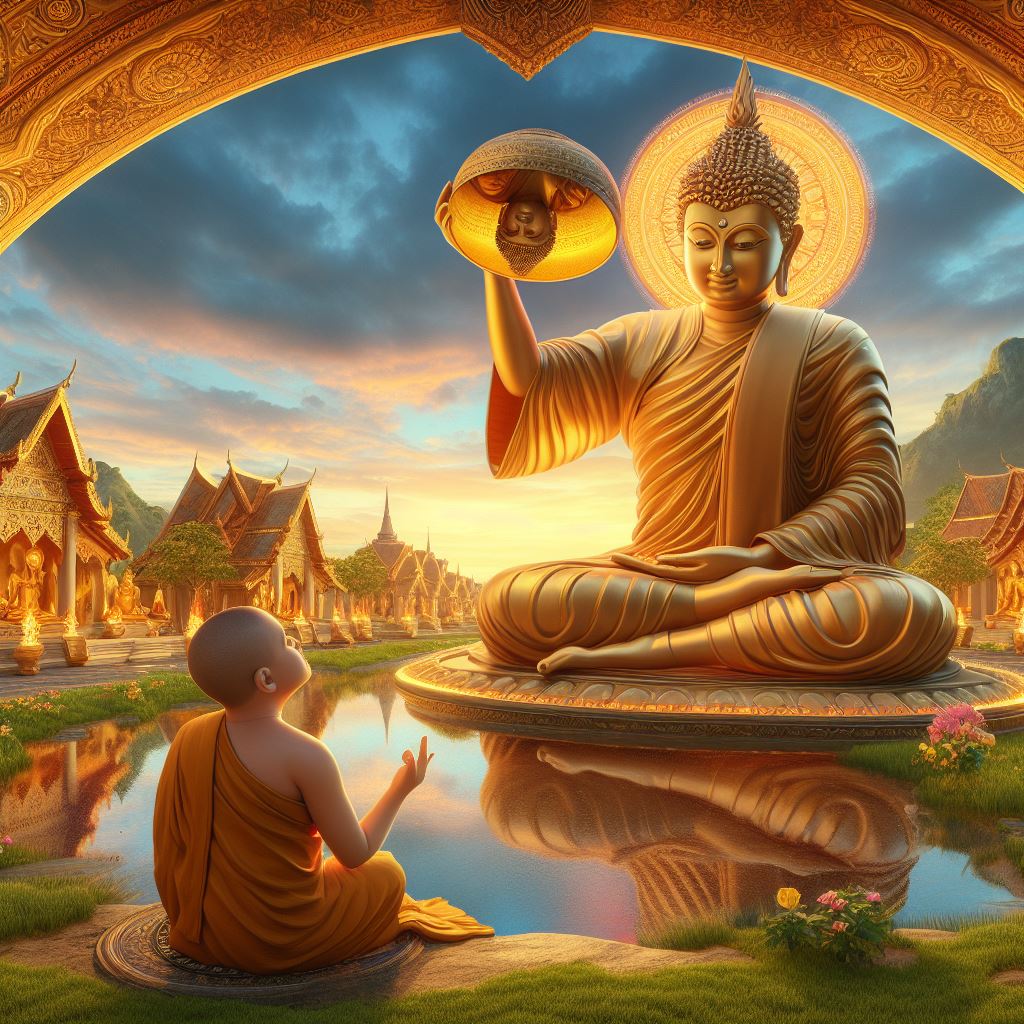
𝐕𝐢𝐫𝐭𝐮𝐞 (𝐒𝐢̄𝐥𝐚): In the first story (1. Ambalatthika-rahulovada Sutta: Instructions to Rahula at Mango Stone (Middle Length Discourse 61)), the Buddha teaches his son Rahula about living a life of integrity. When Rahula told a deliberate lie at the age of eight, the Buddha used a simple yet powerful analogy to convey the importance of truthfulness. He explained that someone unashamed of lying has a spiritual life as empty as an upside-down bowl. The Buddha emphasized the need to avoid falsehood, even in jest.
This approach highlights the ineffectiveness of harsh punishment in disciplining children and underscores the significance of imparting moral values calmly. After addressing the lie, the Buddha urged Rahula to reflect on the consequences of his actions, focusing on whether they bring harm or benefit. This approach shifts the moral framework from absolutes to self-awareness and empathy.
The Buddha’s guidance stresses the importance of cultivating a child’s capacity for empathy, emphasizing the role of parental modeling. He also encouraged Rahula to admit mistakes and seek guidance from wise individuals when harm is done. This highlights the crucial role parents play in nurturing a child’s integrity, as children are more likely to be honest when they are in a trusting and supportive environment rather than a punitive one.
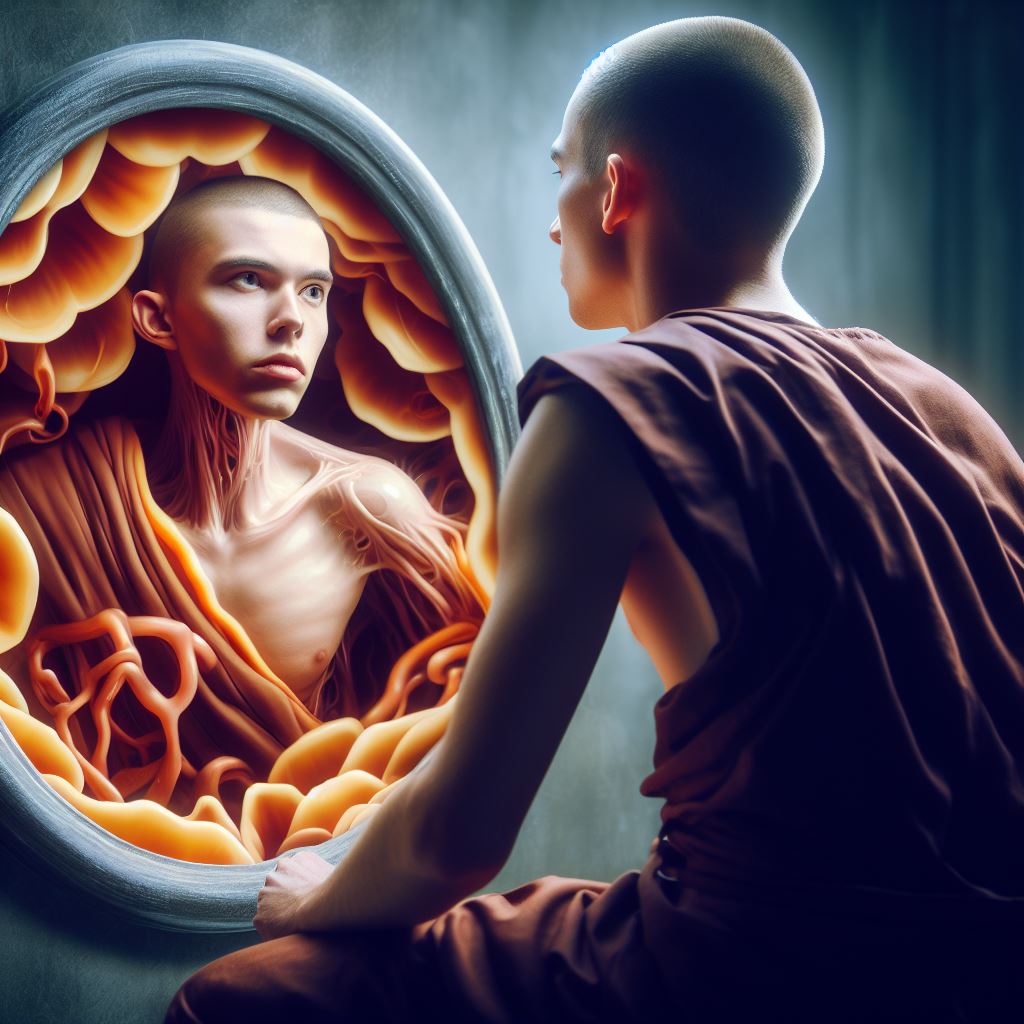
𝐌𝐞𝐝𝐢𝐭𝐚𝐭𝐢𝐨𝐧 (𝐒𝐚𝐦𝐚̄𝐝𝐡𝐢): The second story (2. Maha-Rahulovada Sutta: The Greater Exhortation to Rahula (Middle Length Discourse 62)) illustrates how the Buddha introduced meditation to his son Rahula as a means to nurture inner well-being. At a young teen, Rahula expressed vanity about his appearance to his father during their morning almsround. The Buddha responded by teaching him a profound lesson on the consequences of self-attachment through identifying with the physical body or any mental aspects.
This teaching raises questions about admonishing a teenager for feelings of vanity and interfering with their normal developmental process. However, the Buddha’s response becomes clear in his subsequent guidance. After Rahula’s request for instruction in breathing meditation, the Buddha used analogies to explain how to maintain equanimity during meditation, emphasizing the importance of qualities like lovingkindness, compassion, sympathetic joy, and equanimity. Only then did he teach Rahula breath meditation in sixteen stages, highlighting its power in cultivating inner well-being and preparing for the moment of one’s death.
This approach offers an alternative to rigid self-conceptions and underscores the importance of inner tranquility. It’s a method that can help adolescents navigate the challenges of self-identity and find stability and peace during their teenage years. Additionally, breath meditation is emphasized as a valuable practice throughout life, including in preparing for the end of one’s life.
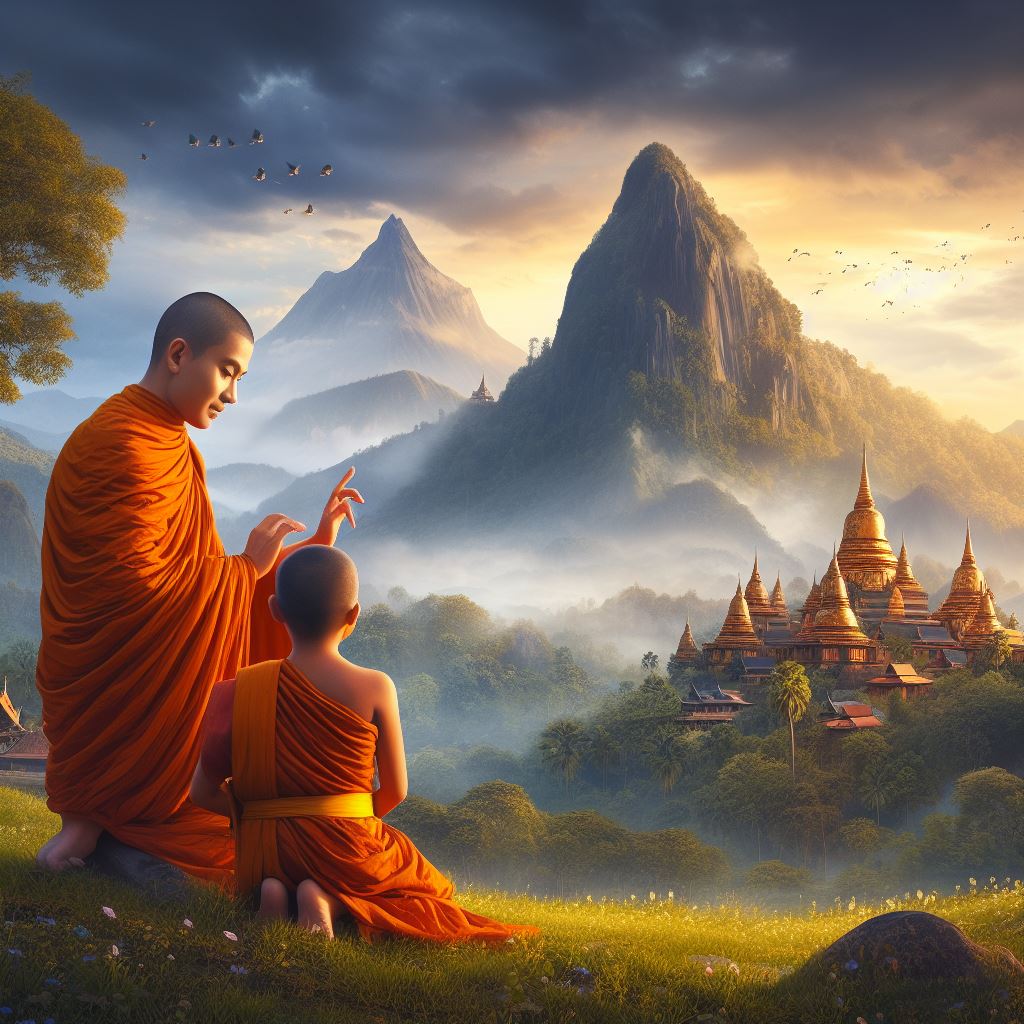
𝐖𝐢𝐬𝐝𝐨𝐦 (𝐏𝐚𝐧̃𝐧̃𝐚̄): In the final sutta (3. Cula-Rahulovada Sutta: The Shorter Exposition to Rahula (Middle Length Discourse 147), the Buddha guides his devoted son Rahula toward liberating wisdom. By this time, Rahula had dedicated much of his teenage years to the path of awakening, demonstrating exceptional commitment to training. When Rahula turned twenty, his father recognized that he was close to achieving liberation. The Buddha took his son deep into the woods, where he led Rahula through a comprehensive series of questions aimed at unraveling the clinging to the concept of a self. For someone as well-trained as Rahula, shedding the deeply ingrained belief in an essential self can be the last obstacle to liberation. The Buddha’s teaching on not-self is not merely abstract philosophy but practical instruction on finding happiness through letting go.
The setting in nature is significant, as it highlights the different perspectives and sense of peace that nature provides, facilitating the release of self-concern. The experience of contemplating letting go amidst a quiet grove of trees contrasts with doing so in the confines of urban life. This sutta emphasizes the importance of self-discovery within the context of the natural world.
The story of Rahula’s journey illustrates how the pursuit of awakening is the greatest happiness in Buddhism. The hope for one’s children is to lead them on the path of awakening, providing them with the peace, happiness, and safety that it offers. The three trainings of virtue, meditation, and wisdom are essential components of this path.
May whatever you wish or want quickly come to be, may all your aspirations be fulfilled, as the moon on the fifteenth (full moon) day, or as a radiant, bright gem.
Sabbītiyo vivajjantu Sabba-rogo vinassatu Mā te bhavatvantarāyo Sukhī dīgh’āyuko bhava.
May all distresses be averted. may every disease be destroyed. May there be no dangers for you. May you be happy & live long.
For one of respectful nature who constantly honors the worthy, Four qualities increase: long life, beauty, happiness, strength.
Āyurārogya sampatti – sagga sampatti meva ca Ato nibbāna sampatti – iminā te samijjhatu!
Through these wholesome deeds, May you achieve the wealth of long life, good health, and a place of happiness, And eventually may you attain Nibbana, the Supreme Bliss!
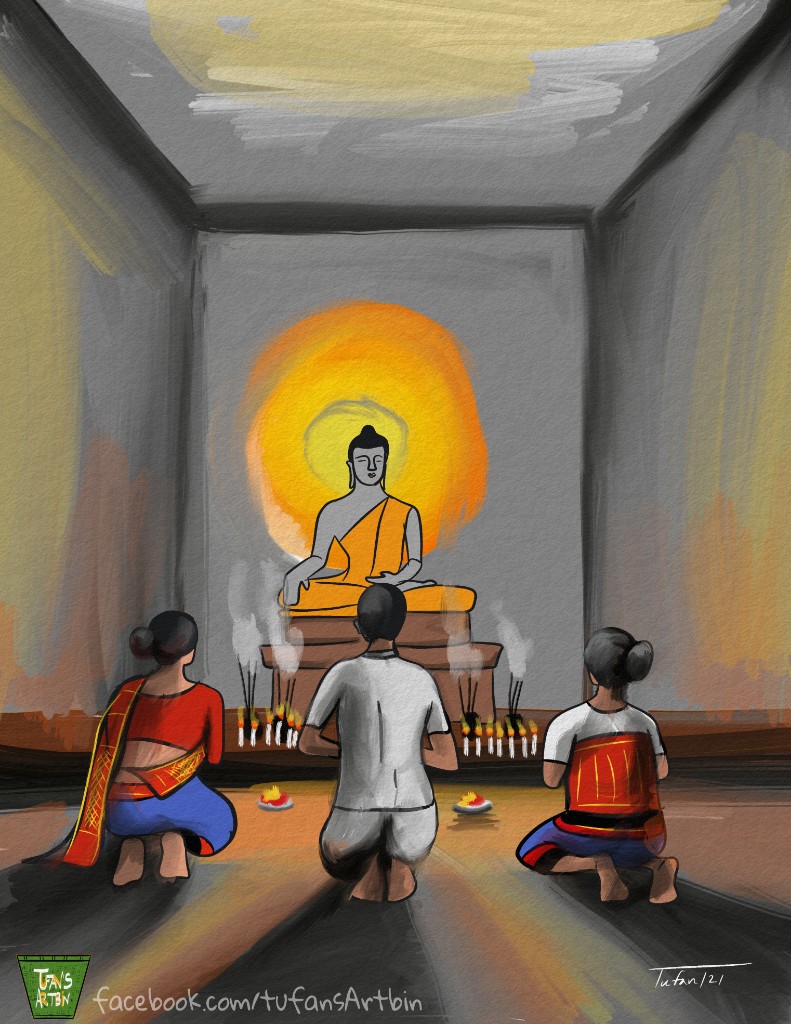
To pay respect to, and ask forgiveness of, the Buddha’s relics, relics of the Noble Disciples, Buddha images, stupas, the Bodhi tree — all of which are objects that all Buddhists should respect, both inwardly and outwardly:
[Ratanattayamagāra pāṭha] Arahaṃ sammā-sambuddho bhagavā. The Blessed One is Worthy & Rightly Self-awakened. Buddhaṃ bhagavantaṃ abhivādemi. I bow down before the Awakened, Blessed One.
(BOW DOWN)
Svākkhāto bhagavatā dhammo. The Dhamma is well-expounded by the Blessed One. Dhammaṃ namassāmi. I pay homage to the Dhamma.
(BOW DOWN)
Supaṭipanno bhagavato sāvaka-saṅgho. The Sangha of the Blessed One’s disciples has practiced well. Saṅghaṃ namāmi. I pay respect to the Sangha.
(BOW DOWN)
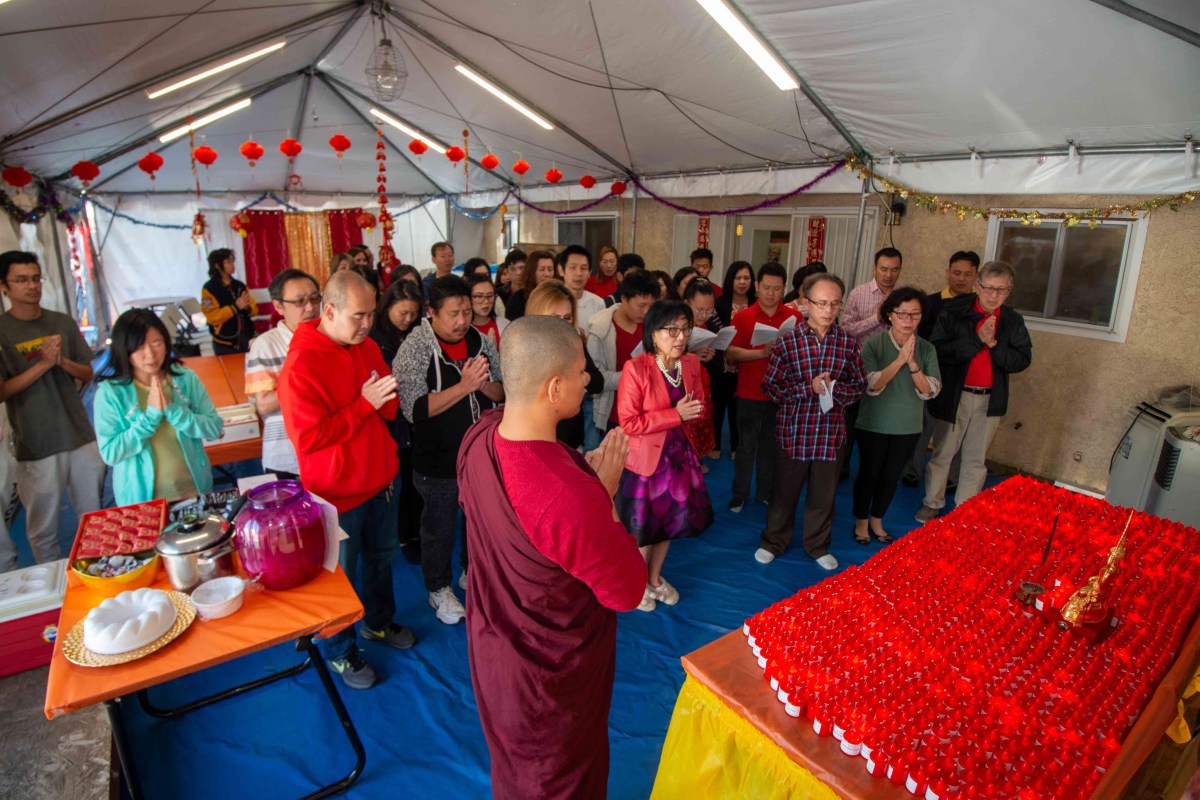
Asking for Forgiveness from the Bhante Laity: Okāsa, ahaṃ (mayaṃ) bhante, dvārattayena kataṃ sabbaṃ aparādhaṃ khamatu me (no) bhante. I (we) ask for your leave. I (we) ask you to forgive me (us) for whatever wrong I (we) have done with the three doors (of body, speech, & mind).
Laity: Okāsa, ahaṃ bhante, tisaraṇena saha pañca sīlaṃ dhammaṃ yācāmi, anuggahaṃ katvā sīlaṃ detha me bhante. Permit me, Bhante, I ask for the three refuges together with the five precepts. Please, Bhante, kindly administer the precepts to me.
Dutiyaṃpi,Okāsa, ahaṃ bhante, tisaraṇena saha pañca sīlaṃ dhammaṃ yācāmi, anuggahaṃ katvā sīlaṃ detha me bhante. A second time permit me, Bhante, I ask for the three refuges together with the five precepts. Please, Bhante, kindly administer the precepts to me.
Tatiyaṃpi,Okāsa, ahaṃ bhante, tisaraṇena saha pañca sīlaṃ dhammaṃ yācāmi, anuggahaṃ katvā sīlaṃ detha me bhante. A third time permit me, Bhante, I ask for the three refuges together with the five precepts. Please, Bhante, kindly administer the precepts to me.
Monk: Yamahaṃ vadāmi taṃ vadetha. Repeat after me.
Laity: Āma bhante. Yes Bhante.
Monk: Namo tassa bhagavato arahato sammā-sambuddhassa. (Three times.) Homage to the Blessed One, the Worthy One, the Rightly Self-awakened One.
Laity: Namo tassa bhagavato arahato sammā-sambuddhassa. (Three times.) Homage to the Blessed One, the Worthy One, the Rightly Self-awakened One.
(Tisaraṇa-Three Refuges)
Monk: Buddhaṃ Saraṇam Gacchāmi. Dhammaṃ Saraṇam Gacchāmi. Saṅghaṃ Saraṇam Gacchāmi. I go to the Buddha for refuge I go to the Dhamma for refuge I go to the Sangha for refuge
Laity: Buddhaṃ Saraṇam Gacchāmi. Dhammaṃ Saraṇam Gacchāmi. Saṅghaṃ Saraṇam Gacchāmi. I go to the Buddha for refuge I go to the Dhamma for refuge I go to the Sangha for refuge
Monk: Dutiyaṃpi, Buddhaṃ Saraṇam Gacchāmi. Dutiyaṃpi, Dhammaṃ Saraṇam Gacchāmi. Dutiyaṃpi, Saṅghaṃ Saraṇam Gacchāmi. For a second time, I go to the Buddha for refuge For a second time, I go to the Dhamma for refuge For a second time, I go to the Saṅgha for refuge
Laity: Dutiyaṃpi, Buddhaṃ Saraṇam Gacchāmi. Dutiyaṃpi, Dhammaṃ Saraṇam Gacchāmi. Dutiyaṃpi, Sanghaṃ Saraṇam Gacchāmi. For a second time, I go to the Buddha for refuge For a second time, I go to the Dhamma for refuge For a second time, I go to the Sangha for refuge
Monk:Tatiyaṃpi, Buddhaṃ Saraṇam Gacchāmi. Tatiyaṃpi, Dhammaṃ Saraṇam Gacchāmi. Tatiyaṃpi, Sanghaṃ Saraṇam Gacchāmi. For a third time, I go to the Buddha for refuge For a third time, I go to the Dhamma for refuge For a third time, I go to the Sangha for refuge
Laity:Tatiyaṃpi, Buddhaṃ Saraṇam Gacchāmi. Tatiyaṃpi, Dhammaṃ Saraṇam Gacchāmi. Tatiyaṃpi, Sanghaṃ Saraṇam Gacchāmi. For a third time, I go to the Buddha for refuge For a third time, I go to the Dhamma for refuge For a third time, I go to the Sangha for refuge
Monk: Tisaraṇa Gamanaṃ Paripunnaṃ. Taking Three Refuges are complete.
Laity: Āma bhante. Yes, Bhante.
Pañcasīla-Five Precepts
Monk: Pānātipātā Veramaṇi Sikkhā-padaṃ Samādiyāmi. I undertake the training rule of refraining from killing living creatures. Laity: (Repeat after the monk)
Monk: Adinnādānā Veramaṇi Sikkhā-padaṃ Samādiyāmi. I undertake the training rule of refraining from taking what has not been given. Laity: (Repeat after the monk)
Monk: Kāmesu Micchācārā Veramaṇi Sikkhā-padaṃ Samādiyāmi. I undertake the training rule of refraining from sexual misconduct Laity: (Repeat after the monk)
Monk: Musāvādā Veramaṇi Sikkhā-padaṃ Samādiyāmi. I undertake the training rule of refraining from false speech Laity: (Repeat after the monk)
Monk: Surameraya-majjha-pamādaṭṭhānā Veramaṇi Sikkhā-padaṃ Samādiyāmi. I undertake the training rule of refraining from liquor, wines, or intoxicants which cause heedlessness. Laity: (Repeat after the monk)
Monk: Tisaraṇena Saha Pañca Sīlaṃ Dhhammaṃ Sādhukaṃ Surakkhitaṃ Katvā Appamādena Sampādetha. Having well undertaken and kept the five precepts, together with the three refuges, one should strive on with diligence.
Laity: Āma Bhante. Yes, Bhante.
Monk: Sīlena sugatiṃ yanti, Sīlena bhoga‧sampadā, Sīlena nibbutiṃ yanti, Tasmā sīlaṃ visodhaye. With morality, good rebirth is gained; With morality, wealth is achieved; With morality, perfect peace is attained. Therefore, morality should be puri
Then the householder Anāthapiṇḍika approached the Blessed One, paid homage to him, and sat down to one side. The Blessed One then said to him:
“Householder, there are these five things that are wished for, desired, agreeable, and rarely gained in the world. What five? Long life, householder, is wished for, desired, agreeable, and rarely gained in the world. Beauty … Happiness … Fame … The heavens are wished for, desired, agreeable, and rarely gained in the world. These are the five things that are wished for, desired, agreeable, and rarely gained in the world.
“These five things, householder, that are wished for, desired, agreeable, and rarely gained in the world, I say, are not obtained by means of prayers or aspirations. If these five things that are wished for, desired, agreeable, and rarely gained in the world could be obtained by means of prayers or aspirations, who here would be lacking in anything?
(1) “Householder, the noble disciple who desires long life ought not to pray for long life or delight in it or passively yearn for it. A noble disciple who desires long life should practice the way conducive to long life. For when he practices the way conducive to long life, it leads to obtaining long life, and he gains long life either celestial or human.
(2) “Householder, the noble disciple who desires beauty … (3) … who desires happiness … (4) … who desires fame ought not to pray for fame or delight in it or passively yearn for it. A noble disciple who desires fame should practice the way conducive to fame. For when he practices the way conducive to fame, it leads to obtaining fame, and he gains fame either celestial or human.
(5) “Householder, the noble disciple who desires the heavens ought not to pray for the heavens or delight in them or passively yearn for them. A noble disciple who desires the heavens should practice the way conducive to heaven. For when he practices the way conducive to heaven, it leads to obtaining the heavens, and he gains the heavens.”
For one desiring long life, beauty, fame, acclaim, heaven, high families, and lofty delights following in succession, the wise praise heedfulness in doing deeds of merit.
Being heedful, the wise person secures both kinds of good: the good in this life, and the good of the future life. By attaining the good, the steadfast one is called one of wisdom.
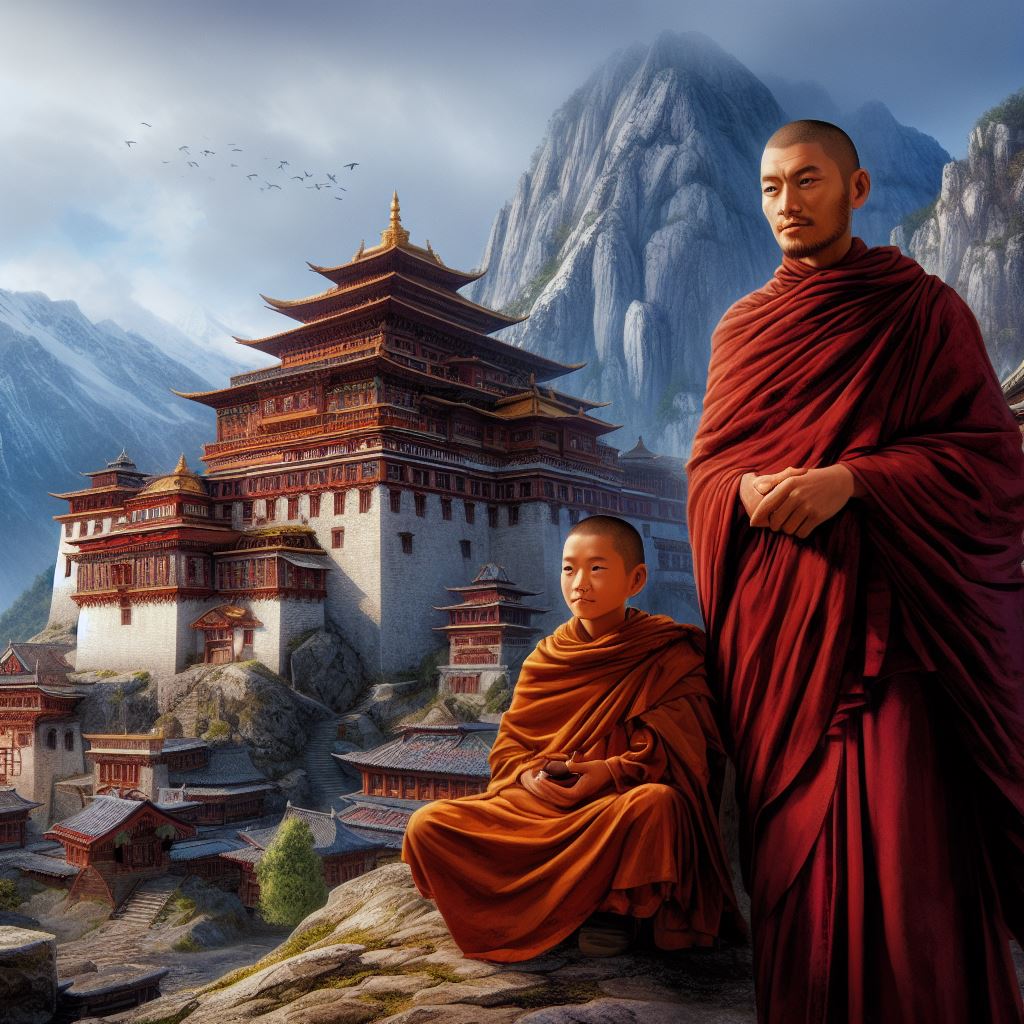
Four things should not be looked down upon and despised because they are young. They are –
A serpent
A fire
A prince
A novice monk
The bite of even a small snake may kill. A little fire may become a huge inferno that destroys building and forests. An enraged young prince may ruthlessly cause harm to others. Even a young monk may be a saint.





 Karuna Buddhist Society